
Steven Seinberg
Before Winter
Hanam · November 12 – December 22, 2026
Before Winter
Hanam · November 12 – December 22, 2026
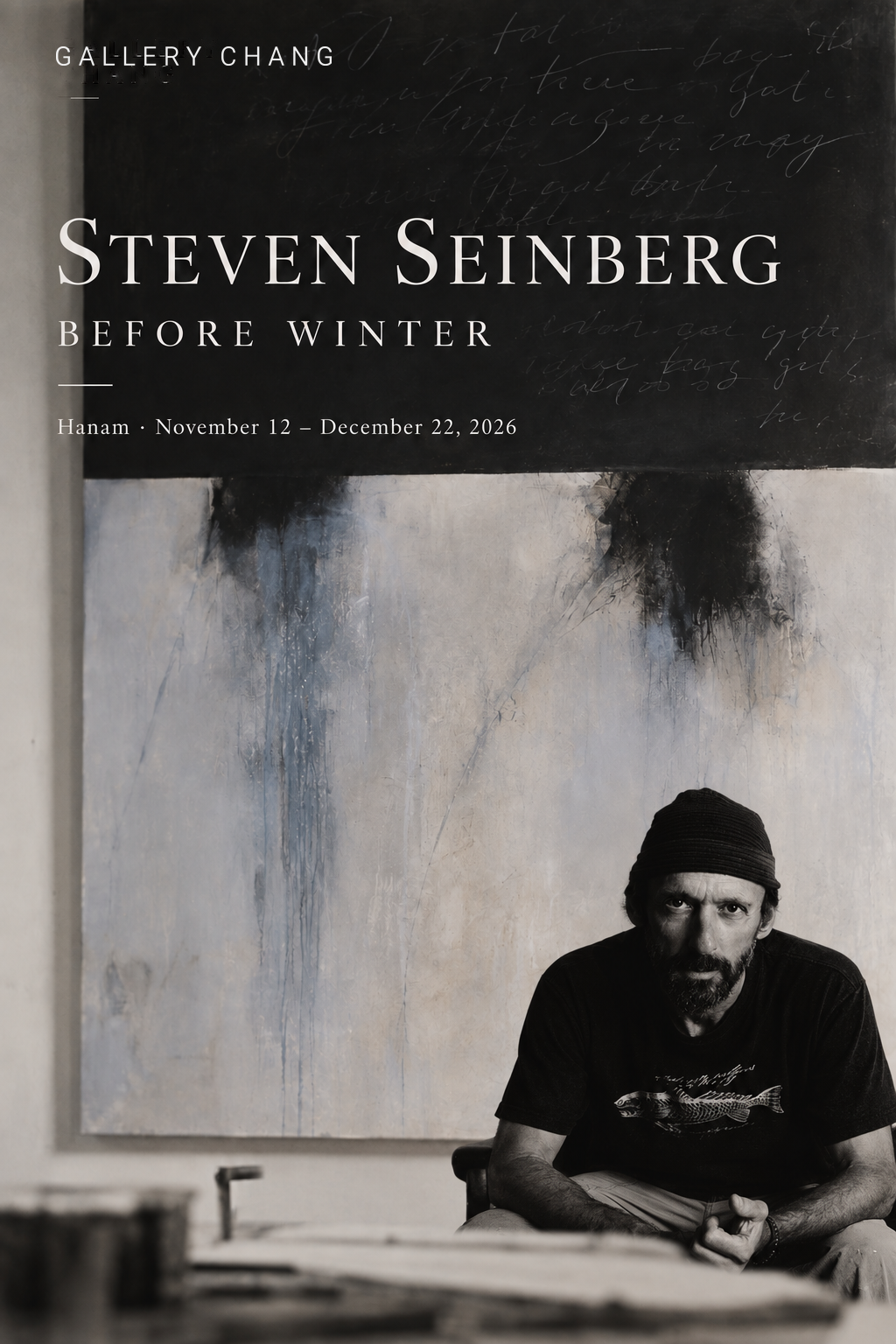
Exhibition poster, Gallery Chang Hanam, 2026
There is a particular stillness before winter arrives.
The light falls lower, the landscape begins to lose its color, and the world seems to withdraw into itself. It is a season of transition—not yet an ending, but a moment suspended between what has passed and what is about to disappear.
Steven Seinberg’s paintings inhabit this quiet interval.
Working through layers of pigment, graphite, erasure, and gesture, Seinberg creates surfaces that seem to emerge and recede at the same time. Lines drift across muted fields of color; forms hover at the edge of recognition before dissolving again. A horizon, a branch, a figure, or perhaps only the memory of one appears briefly, never fully declared.
This ambiguity is central to Seinberg’s practice. His paintings resist fixed interpretation, unfolding instead through suggestion, rhythm, and atmosphere. What may initially resemble a landscape gradually becomes something more internal—a psychological and emotional terrain shaped as much by memory as by observation.
Seinberg’s process is one of accumulation and removal. Marks are added, obscured, scraped away, and allowed to return as traces beneath the surface. In this sense, his paintings mirror the way memory itself operates: not as a stable image, but as fragments repeatedly recalled, altered, and partially lost. What disappears is never entirely absent.
Before Winter brings together works that dwell in this space between presence and disappearance, clarity and uncertainty, attachment and release.
The exhibition takes its title not from winter itself, but from the moment just before it—a brief threshold when the world appears to hold its breath. It is a time when things become quieter, when distance becomes more visible, and when what is about to be lost can suddenly feel more present.
In Seinberg’s paintings, emptiness is never truly empty. The open spaces, faded gestures, and interrupted lines carry their own emotional weight. They suggest that absence can be another form of presence, and that silence can hold as much meaning as speech.
Seen together, the works in Before Winter invite a slower kind of looking. They ask the viewer not to search for a single image or narrative, but to remain within uncertainty—to notice what appears, what disappears, and what continues to linger.
Silence is not emptiness. It is where memory, longing, and time quietly gather.
Installation view
Gallery Chang Hanam, 2026
Installation view
Gallery Chang Hanam, 2026
Installation view
Gallery Chang Hanam, 2026
Artist Name
Title of Work, 2026
Oil on canvas
100 × 80 cm
Artist Name
Title of Work, 2026
Oil on canvas
100 × 80 cm
Artist Name
Title of Work, 2026
Oil on canvas
100 × 80 cm
Steven Seinberg
Portrait of Steven Seinberg
Steven Seinberg (b. 1969) is an American abstract painter whose work explores the relationship between nature, perception, memory, and emotional experience. Born in Brooklyn and educated at the Atlanta College of Art and Georgia State University, Seinberg has developed a highly recognizable visual language rooted in the legacy of Abstract Expressionism while remaining distinctly contemporary. His paintings often evoke the atmosphere and openness associated with artists such as Cy Twombly, Robert Motherwell, Mark Rothko, and Clyfford Still, yet move toward a quieter and more introspective understanding of abstraction.
Working with oil, acrylic, charcoal, and graphite, Seinberg builds surfaces through layers of delicate lines, atmospheric fields, erasures, and gestural marks. His paintings frequently suggest landscapes, biological structures, water, light, or distant horizons without ever resolving into literal representation. Instead, forms appear to emerge and disappear across the surface, creating a sense that the viewer is witnessing something in a constant state of transformation—from the microscopic to the cosmic, from physical nature to memory and emotion.
Seinberg is significant for extending the language of American abstraction into a deeply poetic exploration of the natural world and human perception. Rather than depicting nature directly, he attempts to reveal the invisible rhythms and forces that exist beneath its surface. His work occupies a compelling space between drawing and painting, presence and absence, control and intuition—creating images that feel at once intimate, expansive, and contemplative.